Services / Exercise Stress Test
Exercise Stress Test
A supervised walk on a treadmill while we record your ECG and blood pressure — used to look for coronary disease, arrhythmias, and exercise capacity.
OHIP-insured with requisition
What it is
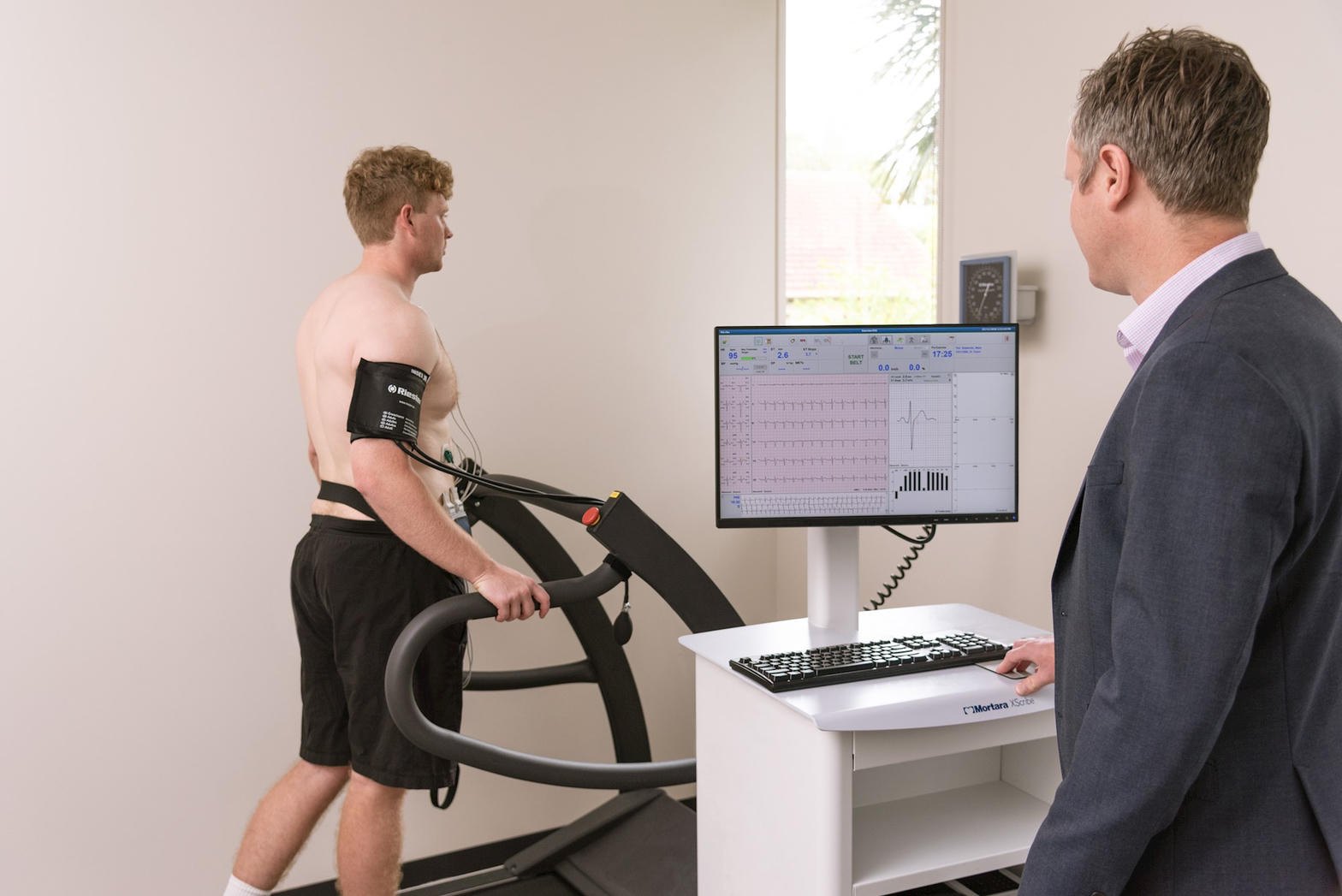
An exercise stress test (GXT) looks at how your heart handles work. Electrodes record your ECG and a cuff tracks blood pressure while you walk on a treadmill that gets a little faster and steeper every three minutes. We watch for symptoms, ECG changes, and blood-pressure response, and we stop if anything concerning appears — or when you reach your target heart rate.
Why it is ordered
- Investigate chest pain, unexplained breathlessness, or reduced exercise tolerance
- Look for signs of coronary artery disease
- Evaluate known arrhythmias during effort
- Establish a safe exercise prescription after a cardiac event
Before your visit
- 01Wear comfortable walking shoes and loose clothing
- 02Avoid caffeine for 24 hours before the test
- 03Do not eat a heavy meal in the two hours beforehand; a light snack is fine
- 04Your physician will tell you if any heart medications should be held
- 05Bring inhalers if you use them, plus your health card and requisition
During the test
- 01We review your history and calculate a target heart rate
- 02Electrodes are placed on the chest; a blood-pressure cuff stays on one arm
- 03You start walking at a gentle pace; speed and incline rise every 3 minutes
- 04Tell us immediately about chest pain, dizziness, or unusual shortness of breath
- 05You may stop the test at any time; we also stop for safety criteria
After
- 01You recover in a chair while we continue to monitor ECG and blood pressure
- 02Most people go home and resume usual activity the same day
- 03A cardiologist interprets the tracing; results go to your referring doctor
Questions we hear often
Ready to refer, or have a question?
Patients: ask your family doctor for a CardioCare requisition, or call us and we will help you get started. Physicians: complete the form — it takes a couple of minutes.